
The World Cup is Cooked
Players and fans are sweating through record heat while sponsors cash the checks.

The World Cup is a magical thing. It’s the most-watched sporting event on Earth, unites dozens of nations, billions of fans, and it’s even responsible for hits like Shakira’s “Waka Waka.” It’s a tournament built on the premise that the world’s most popular sport deserves a planet-sized audience all tuning in together.
If soccer is the one thing that unites the whole world every four years, it’s only fitting that it’s now confronting the one crisis touching nearly every corner of the planet: extreme heat. The last 11 years have been the hottest on record, so it’s no surprise this year’s Cup is shaping up to be the hottest one yet. And conveniently, the polluters and corporate interests fueling that heat get front-row seats, cashing in while the planet, and its fans, bake.
The pitch is sweltering
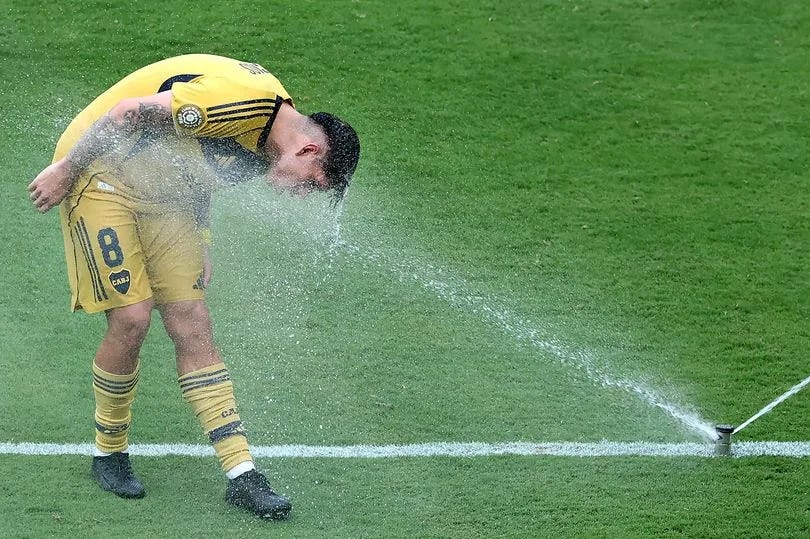
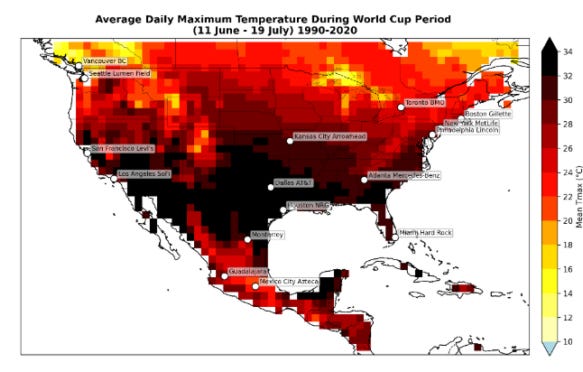
Researchers have spent years quantifying just how hot this World Cup will be, and the numbers are brutal. One analysis projects nearly a quarter of all matches above 26°C (78.8° F), with roughly five games expected to cross 28°C (82.4° F). That’s almost double the rate from the last time the U.S. hosted a World Cup in 1994. Another analysis looked at the same 104 matches and found that up to 26 games could occur in conditions hazardous to player health, across 14 of the 16 stadiums.
Already we’ve seen two of the first round of matches played in conditions severe enough that a football players’ union said it should trigger the delay or postponement of games. And Paraguay and France battled it out in what was one of the hottest matches in World Cup history, with air temperatures hitting 99°F and stadium temperatures topping 150°F.
The effects on the field are brutal on the body. Severe heat pushes heart rates up, fatigues muscles faster, and accelerates dehydration. And that’s for elite athletes who train specifically for this. For fans, only three stadiums have air conditioning, and FIFA won’t even let you bring an empty water bottle in to refill.
The players didn’t wait for the data to confirm what their bodies already knew. Sixty current and former professional players signed an open letter this spring demanding FIFA overhaul its heat-stress framework. As the players put it, a sport already this exposed to the climate crisis doesn’t have the luxury of treating player safety as an afterthought, and has the responsibility to address one of the sport’s most dire threats.
The letter also asked FIFA to reduce its climate impact, with a smaller, more regional football calendar. FIFA did the opposite, expanding this year’s tournament to more teams and cities than ever, a format that depends on intensive air travel for both squads and fans. Now we’re staring down what’s on track to be the most polluting World Cup in history, with emissions expected to top nine million tonnes.
A tournament underwritten by the people causing the problem
Tucked into that same letter is a demand that FIFA drop its fossil fuel sponsors. Starting this all-star line up is the one and only Saudi Aramco as the Cup’s exclusive Global Energy Partner. And to be fair, its impact really is global, with the company accounting for 4% of global emissions in 2024. Other sponsors include Qatar Airways, Coca-Cola, and Bank of America, which financed $47.3 billion in fossil fuels last year alone, making it the industry’s second largest backer.
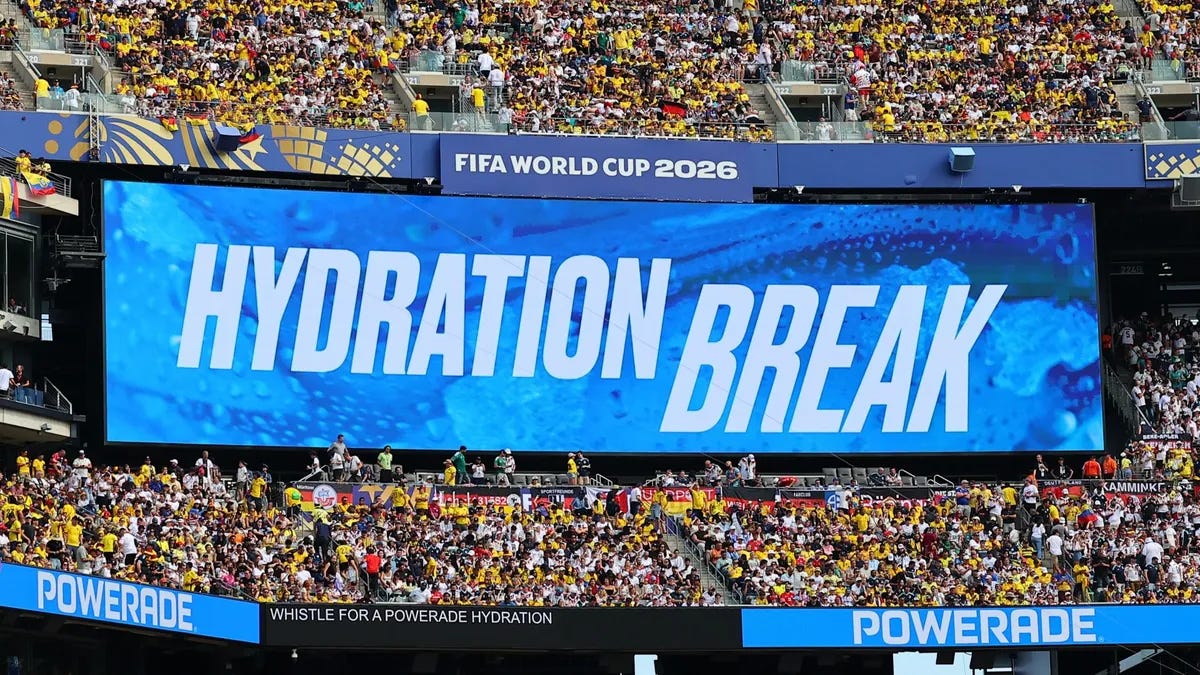
We’ve also had our eye on FIFA’s newly implemented hydration breaks. Many players and medical experts have welcomed the mandatory three-minute pauses as a necessary response to increasingly dangerous heat, but they’ve also drawn criticism for becoming another opportunity to sell advertising. Across 104 matches, those breaks create more than ten extra hours of commercial inventory, with 30-second spots selling for as much as $750,000 during U.S. games. Fox alone is projected to pull in somewhere between $249.6 million and $332.8 million from hydration-break ads, off more than 800 slots tournament-wide.
If extreme heat has become serious enough to stop play, imagine if even a fraction of those breaks were used to help viewers recognize heat illness, explain why the tournament now needs these pauses, or connect the dots between rising temperatures and climate change, instead of simply squeezing in another commercial.
A game without a planet
Soccer is the most accessible sport in the world — all you need is a ball. But what happens when the other ball, the giant one we’re all spinning through the universe on, gets too hot to play on without serious health risk? This summer, temperatures have already topped 100°F in Morocco, Portugal, and Spain, the very countries set to co-host the 2030 World Cup.
FIFA will always have enough money to take care of the cream of the crop, but what about the rising stars who never get the chance because it’s too hot to fall in love with the game in the first place? What happens when the pickup games that turn an interest into a passion into a profession can’t happen because the concrete’s too hot to stand on or the grass has dried up?
Soccer, like everything else we love, isn’t immune to climate change. So why do we keep not only letting the polluters responsible off the hook, but plastering their logos around the field too?