

On Monday, October 5th, more than 100 people gathered outside the U.S. Supreme Court as the justices prepared to hear arguments in Suncor Energy v. Boulder. Wildfire survivors who lost their homes and watched their communities burn stood beside ranchers whose livelihoods are threatened by a changing climate, and beside scientists and lawyers who have spent years documenting climate harms and fighting for accountability. They had come from different places, but they shared one message: let Boulder’s case move forward.
In 2018, Boulder sued ExxonMobil and Suncor Energy, alleging the companies concealed the climate harms of their products and should pay for the damage communities are now enduring. The stakes reach far beyond one city, with more than one in four Americans living in communities that have filed similar suits, each bearing the costs of climate-fueled disasters and asking for their day in court.
Outside the Supreme Court, this was about more than a lawsuit. It was about people whose lives have been upended by fire and drought, and who came to the nation’s highest court hoping to be heard.
Here are the people who showed up, the stories they carried, and why they believe Boulder’s case deserves its day in court.
The Marshall Fire Survivors
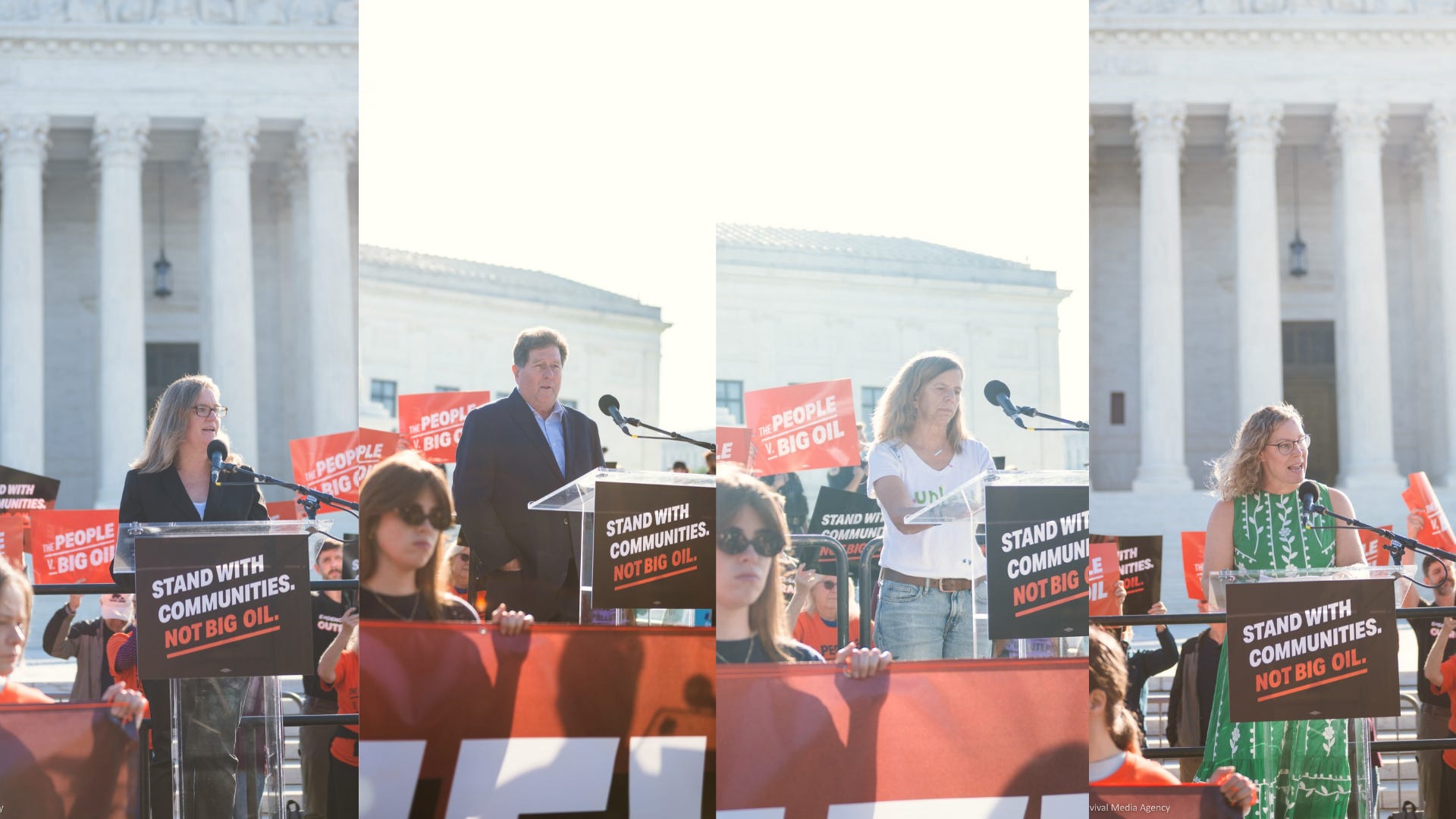
The 2021 Marshall Fire was the most destructive wildfire in Colorado history. It destroyed more than 1,000 homes and businesses and caused over $2 billion in damage. Survivors traveled to D.C. carrying years of displacement, lost homes, and insurance battles.
Jenny Singer-Rupp lost everything in the fire and endured what she has described as an excruciating insurance fight.
“I am asking the Supreme Court to not block this case and let Boulder’s case move forward. Let the evidence be heard. Let survivors have their day in court. We deserve accountability.”
Louie Delaware lost his home, along with roughly 50 others on his street, and spent more than two and a half years displaced before he could rebuild.
“Accountability cannot undo lost time or every climate impact. But it can affirm a basic rule: No company or industry should gain an advantage by hiding facts that people need to protect their health, their communities, and their future. The bottom line is that they knew, they lied, and they must be accountable for their actions.”
Daryl McCool is an artist who called Superior home for nearly 30 years. Since the fire, he has watched neighbors priced out and the community he knew change, and he has spoken publicly about the displacement and gentrification that followed.
“Fossil fuel companies knew the damage they were doing, and they spent decades denying it. We must hold them accountable before it’s too late for more families, more neighbors, and more communities.”
Tawnya Somauroo is a cofounder of Marshall Together and has worked with Colorado lawmakers to push for insurance reform.
“It is profoundly unfair that oil companies keep the profits while me and my neighbors are left with the losses and the cost of adapting. After everything my community has been through, we deserve our day in court.”
The Next Generation
Young people from Boulder County who were impacted by the Marshall Fire filed a friend-of-the-court brief supporting Boulder’s case, and two of them spoke at the rally.
Alina Miranda lost her home and her pets in the Marshall Fire.
“I lost everything in the Marshall Fire, including my pets and my home. For months, my commute to school meandered through charred land dotted with ruined buildings and burn marks on the street left by cars that had exploded from the heat, every day a reminder of what I had lost. My state has a right to protect my health and hold corporations like Suncor responsible for the damage they’ve caused families like mine by prioritizing profit over long-term climate health.”
Maddison Schink still battles anxiety from the fire and now lives near a Suncor refinery.
“My anxiety after the Marshall Fire and navigating the symptoms of a chronic illness, which worsens from living near a Suncor refinery that spews black smoke has fundamentally altered how I experience everyday life.”
The Altadena Fire Survivors
California’s own climate deception lawsuit against major oil companies is on hold while the Supreme Court considers Boulder’s case, so survivors of the 2025 Eaton Fire made the trip too.
Gayle Nicholls-Ali and Rasheed Ali are longtime Altadena residents who lost the home they owned for more than 30 years. Both spoke, and Rasheed is quoted below.
“I’m really disappointed. Now I know this wasn’t just ‘bad luck.’ I’ve since learned that back in the 80s, years before we bought our home, Exxon’s own scientists issued an internal memo that the effects of their petroleum products could be catastrophic. People said we were Extreme Weather Survivors, but now I know we are also Extreme Weather Victims!”
Zaire Calvin is a lifelong Altadena resident who lost both his home and his sister, Evelyn McClendon, in the Eaton Fire.
“The Eaton Fire took my sister and eighteen other people. My family lost five homes, including my childhood home. From Altadena to Boulder, we carry different stories. Today, we stand together in one demand: Let the evidence be heard. Let responsibility be determined. Let the people harmed have a real path to repair. That is the future we are fighting for. Boulder, we stand with you from Altadena.”
The Ranchers
Colorado ranchers are watching drought and fire threaten their livelihoods, and two of them came to speak for rural Colorado.
Dr. Kathryn Bedell is a Colorado rancher and a member of the state Agriculture Commission. She has ranched for almost three decades and is dispersing her entire herd this month.
“This October, I am dispersing my whole herd of cattle. I’ve ranched on the western slope for 27 years and have managed to make it by fires and droughts before, but not when they come every year. There’s no water to grow feed and it’s too hot and dry to keep them any longer.”
Deirdre Macnab is a cattle rancher in Rio Blanco County. After officials in her own county sided with the oil companies, she helped recruit fellow ranchers to support Boulder’s lawsuit.
“These threats from climate change are bankrupting our family ranches and farmers. Extensive drought, high temperatures and strong wind contributed to two terrible wildfires right by my ranch. My neighbor had 60 cows burned to death. Other ranchers lost miles of fence, lost their grazing for the next two years and were forced to sell large numbers of their herds.”
The Lawyer
Corey Riday-White is Legal Director at the Center for Climate Integrity. He spoke to what the day’s arguments could mean for Boulder and for the wave of cases like it.
“Instead of warning the public, the fossil fuel industry launched the most consequential corporate deception campaign in history. They pushed climate disinformation, undermined science and to this day continue to fuel climate chaos and fight against the action their own scientists told them were necessary to avoid catastrophe.”
The Scientist
Gretchen Goldman, President and CEO of the Union of Concerned Scientists, joined the speakers to underscore the science at the heart of the case.
“Exxon’s own scientists had conducted research in the 1970s predicting that fossil fuels would cause dramatic changes to the global climate. Major fossil fuel companies knew this and chose to engage in a coordinated campaign of deception, denial, and delay. Their playbook has included casting doubt on the scientific consensus, funding bogus science, and buying political influence. And now we are all paying the price.”
The Governor
Jay Inslee, former Washington governor, has become a leading national voice against the fossil fuel industry’s push for sweeping legal immunity from climate accountability lawsuits.
“The fossil fuel industry malignantly and maliciously lied to the American people, and I’ll be damned if I let them take away an American right to hold industries accountable and have their day in court. They knew for decades what the consequences of their products were and they chose to lie. This lie is enormous in scope, it is extensive in duration, and it is fatal in application.”
Everyone Deserves Their Day in Court
Boulder isn’t alone. Eleven states, the District of Columbia, two tribal governments, and dozens of municipalities have active cases against oil and gas companies over alleged climate deception, and communities keep filing new ones. Just five days before oral argument, Middlesex County, New Jersey sued ExxonMobil, BP, Shell, and others. The county says Hurricanes Irene, Sandy, and Ida cost it roughly $199.4 million, while associated FEMA awards covered about $33.2 million.
Outside the courthouse, those numbers became people. A damage figure can tell you what a disaster cost, but not what it was like to lose a home, wait years to rebuild, or watch a neighborhood change. Survivors took the microphone and shared their stories, and the crowd listened. Hearing from the people behind the statistics is what makes the stakes real.
Help us keep those voices in front of the country.
Moments like this rally are why we do this work. We’re a finalist for an Anthem Award, presented by the Webby Awards, for our partnership with Lauren Bash and Social Currant after the Altadena fires. Lauren gave voice to the pain wildfire survivors were feeling and showed where accountability belongs. If the stories at the rally moved you, please take a minute to vote and share. Sign in with your email, cast your vote, and pass it on.